- The Unwestern
- Posts
- How the West Built—and Broke—Haiti
How the West Built—and Broke—Haiti
Our first Unwestern Untold uncovers how Haiti was punished for winning its freedom.

Nathaniel Nepomuceno
July 29, 2025
Welcome to Unwestern Untold - a series of sharp mini-essays that spotlight the people, places, and stories the Western media too often overlooks.
I’m aiming to publish at once per month (maybe twice) on Tuesday and it will be available for everyone. Not just subscribers!
So please share it to anyone you’d like and feel free to leave any feedback for me.
Hope you enjoy!
Were you forwarded this email? Subscribe here to receive your weekly digest of news beyond the Western news cycle.
What do you think when you hear the word “Haiti”?
For me, it evokes the memory of me sitting in my 5th grade classroom, watching news coverage of the catastrophic 2010 earthquake, which killed about 160,000 people, and our school collecting money to send to Haiti.
What I didn’t know at that time was how certain parts of the media were portraying Haiti.
The mantra “Haiti is the poorest country in the Western Hemisphere” was repeated over and over.
An American televangelist Pat Robertson claimed that the earthquake occurred because the people of Haiti literally “made a pact with the devil.”
Even New York Times columnist David Brooks tied Haiti’s poverty to the influence of voodoo.
Overall, a study showed that US media - across the political spectrum - paint the picture of Haiti “as a terminally dysfunctional failed state wracked by violence and endemic corruption.”
When someone says “Haiti,” many Americans think: poor, corrupt, and aid-dependent.
A New Crisis, Ignored
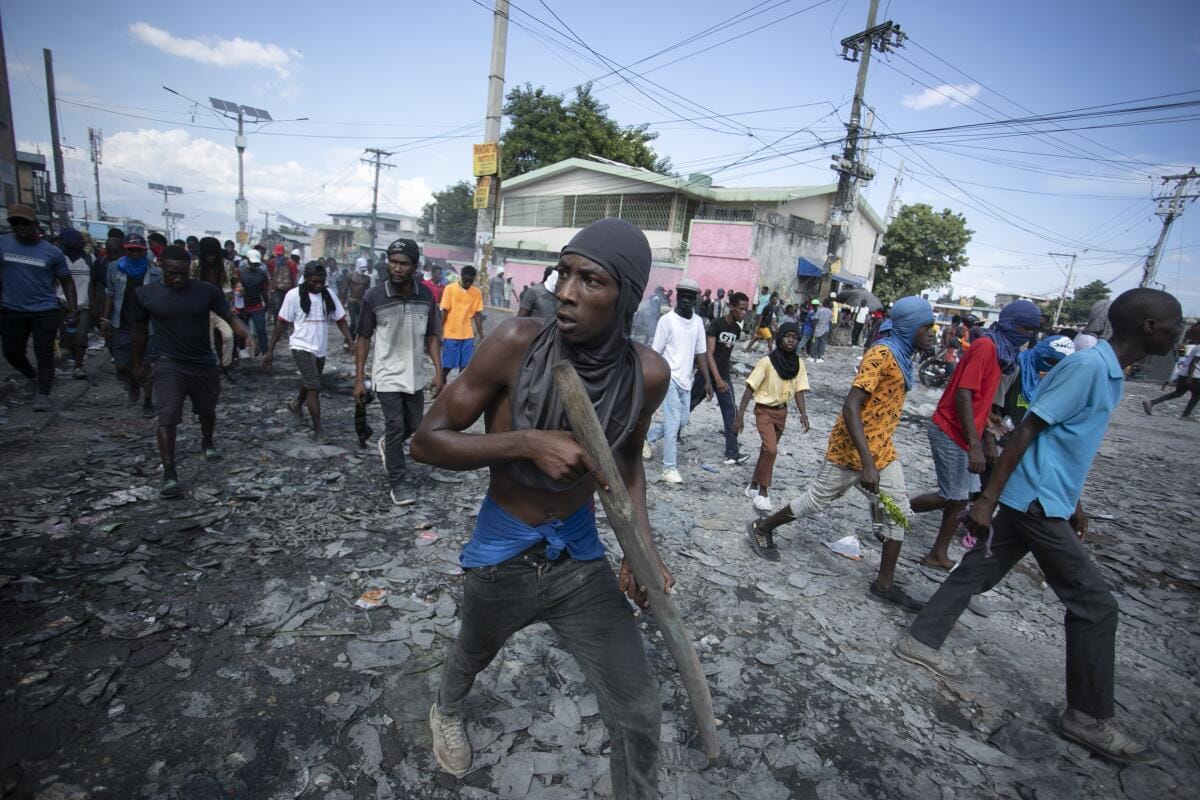
Today, Haiti faces a crisis just as dire as in 2010 only with far less media coverage.
Haitians have not gone to the polls since 2016.
They have not had a president since his assassination in 2021.
Armed gangs now control 85% of the capital, Port-au-Prince, and have expanded further into the country.
So far in 2025 alone:
2,680 people have been killed
316 kidnapped for ransom
Only 20% of health facilities are still operational
5.7 million Haitians—half the population—face acute food insecurity
Yes, Haiti is a poor country. It is one that suffers with a significant amount of corruption.
But we cannot list these facts without asking: why?
And the answer isn’t that Haiti is cursed.
But, it is repeatedly destabilized, exploited, and ignored by the West and the international community.
To understand how Haiti got here, you have to understand what was taken from it.
How the West Made and Broke Haiti
The island of Hispaniola, where Haiti lies, was colonized first by Spain, then divided.
France took the western third, which became one of the most profitable colonies in the world.
By the late 1700s, French Saint-Domingue (modern-day Haiti) was producing 60% of the world’s coffee and 40% of France and Britain’s sugar—built on the backs of 700,000 enslaved Africans.
This brutal economy was regulated by Code Noir, a set of laws passed by the French crown that codified enslaved people as property, enforced conversion to Catholicism, and prescribed barbaric punishments for resistance. The average life expectancy of a slave was just 21 years.
To keep control, the French imposed a three-tier caste system:
White colonists at the top
Free people of color (mulattos) in the middle
Black slaves at the bottom
Mulattos - often the children of white planters and enslaved women - held property and were educated, but they too were denied full rights.
This manufactured hierarchy fractured Haitian society and that fracture would outlive France’s rule.
The brutality sparked rebellion in 1791. Over 13 chaotic years, alliances shifted constantly; enslaved Haitian forces allied with Spain, then France, then turned against both.
Some mulattos fought for full emancipation; others protected their own privileges.
Eventually, when Napoleon tried to reimpose slavery, revolutionaries and sympathetic mulattos united under leaders like Toussaint Louverture and Jean-Jacques Dessalines.
In 1804, Haiti declared itself free from France - a Black-led republic born from revolution, and the first nation in the Americas to abolish slavery.
But that freedom came with a cost.
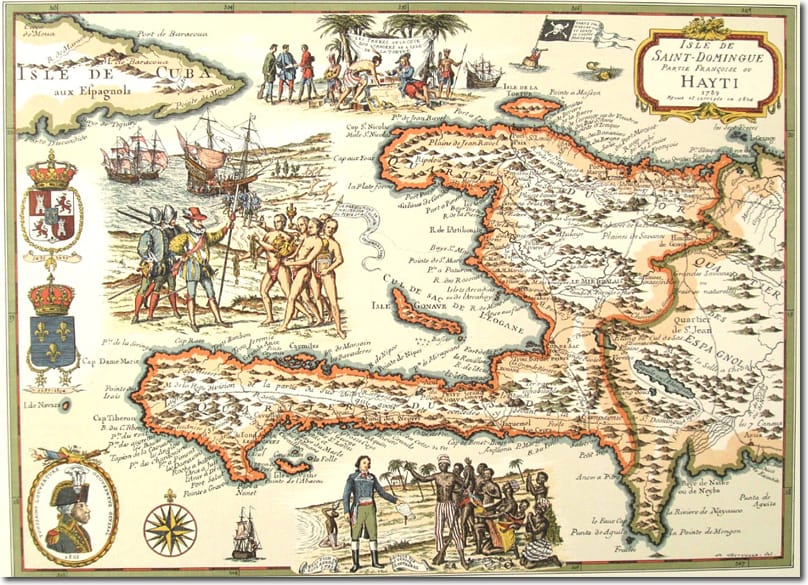
Map of Saint-Domingue (modern-day Haiti) in 1789
A Debt to be Repaid
Dessalines, fearing re-enslavement and foreign plots, ordered the genocide of most of the remaining white population - killing 3,000-7,000 people. Though horrific, it must be understood as a reaction to centuries of slavery and the ever-present threat of recolonization.
The global response was swift and cold: Europe and the United States refused to recognize Haiti, isolating it politically and economically.
This prevented merchants to trade with Haiti, choking a key source of revenue and development.
Meanwhile, the divisions France engineered didn’t disappear.
After Dessalines’s assassination in 1806, civil war erupted between Black and mulatto elites.
The north fell under Henri Christophe, a Black monarch; the south under Alexandre Pétion, a mulatto republican. Their split reflected more than geography—it mirrored the caste tensions that France had embedded.
This rivalry delayed national unity, fractured institutions, and set the tone for decades of internal struggle.
But Haiti’s greatest burden wasn’t internal—it was financial.
In 1825, just two decades after independence, France returned with warships and a demand: pay reparations for the loss of “property”—including enslaved people.
Under threat of invasion, Haiti agreed to pay 150 million francs, a staggering sum that took over a century to repay.
This so-called “Independence Debt” was the world’s first and only example of formerly enslaved people paying their enslavers. To meet the payments, Haiti took out loans from French banks—entering a cycle of debt and dependency that would strangle its economy for generations.
If the Independence Debt was invested into the Haitian economy instead, it could be valued at $115 billion.
And the isolation continued. The United States didn’t recognize Haiti until 1862. Foreign investors avoided it. Trade deals were scarce. When help came, it often came with strings.
Modern Colonialism
In 1915, the U.S. invaded Haiti and occupied the country for 19 years, citing instability and debt default.
But during the occupation, the U.S. Marines ruled Haiti as a military regime. The U.S. rewrote Haiti’s constitution, controlled its finances, and restructured its economy to benefit American business interests.
Forced labor was reintroduced. Roads were built not for Haitians, but for easier troop movement and export routes.
U.S. Marines formed and trained the Gendarmerie d’Haïti (later the Haitian Army) to massacre local dissent, centralizing the government. This militarized structure endured, contributing to later authoritarianism.
The U.S. Marines killed thousands of Haitians, both rebels and civilians, with estimates up to 15,000 lives.
After the occupation ended, Haiti never regained full political sovereignty.
Its economy remained tied to foreign lenders.
Its political institutions, hollowed out.
And in the vacuum, strongmen rose.
From 1957 to 1986, Haiti was ruled by the Duvaliers—François “Papa Doc” and later his son, Jean-Claude “Baby Doc.”
Tolerated by the U.S. in the name of anti-Communism, the Duvaliers enriched themselves while using death squads (the Tonton Macoutes) to terrorize the population. Thousands were killed. Billions were stolen.
When Baby Doc finally fled, with the support of the US, Haiti was left with weak democratic institutions, foreign debt, and deep wounds—physical, economic, and psychological.
That legacy paved the way for the crisis we see today.
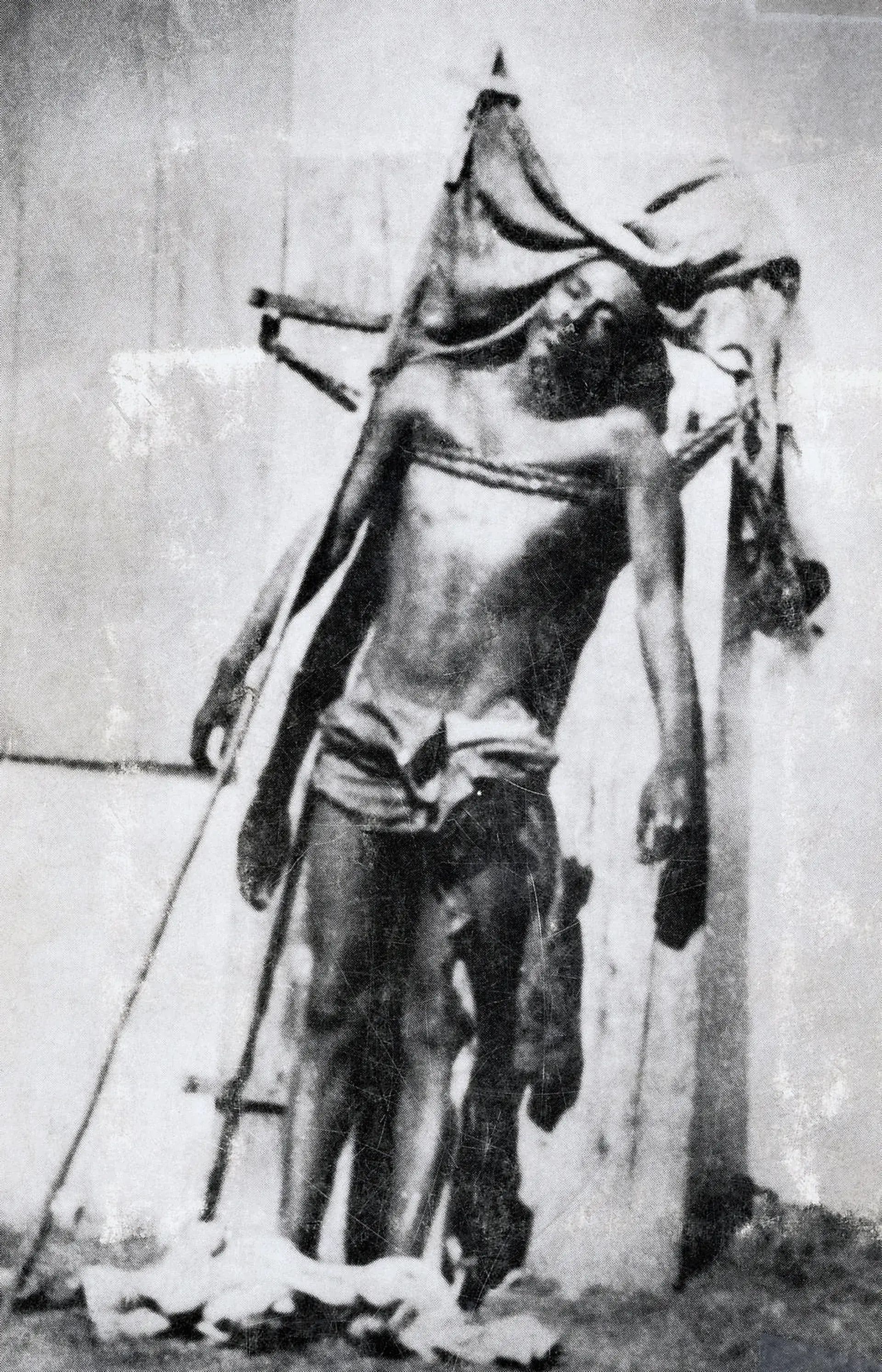
The photograph of Charlemagne Péralte - a Haitian rebel killed by the US - that was distributed to Haitians to sow fear.
The West Looks Away
In the nearly four decades since, Haiti has cycled through 19 different heads of state and experienced 5 successful coups - some supported by the CIA.
Efforts to stabilize the country have been inconsistent, deprioritized, and chronically underfunded.
Only 8.4% of the 2025 UN Humanitarian Response Plan for Haiti has been funded.
After China and Russia vetoed a formal peacekeeping force, the UN assembled a voluntary security coalition known as the MSS mission.
It was meant to be a temporary measure. But its limitations are showing.
Canada leads funding with $63 million, followed by the U.S. ($15 million) and France ($8 million). The U.S. also contributed $300 million via a separate fund.
But in February 2025, President Trump froze $13.3 million in pending U.S. aid, leaving the mission severely under-equipped and undermanned.
Planned officers: 2,500
Actually deployed: 1,000
Haitian leaders have called for converting MSS into a formal UN peacekeeping mission, which would unlock dues-based funding for the estimated $600 million cost.
A Security Council vote on MSS’s renewal is scheduled for October 2025. But now, U.S. backing is uncertain.
So no, Haiti is not cursed, but it is haunted by the consequences of their colonizers.
Haiti was built on the backs of slaves taken from their homes 7,000 miles away. They revolted against one of the largest empires in the world - and won. But, their formal masters have been punishing them ever since.
Through the power of debt, manufactured class divides, and international indifference.
Today, Haiti is in a deep crisis, but as historian Laurent Dubois says,
“A different Haiti is—always, and still—possible.”
But only if we reckon with its history, with debt, and the way the world still chooses to look away.
The people of Haiti do not need another article saying “Haiti is the poorest country in the Western Hemisphere.”
The people of Haiti do not need pity and empty prayers.
They need justice and for the international community to step up.
📢 What Now?
If this story challenged what you thought you knew about Haiti, share it or check out the suggested reading/watching below!
Haiti’s past isn’t just history, but a lesson on how power works, and who pays the price when the world turns away.
📚Extra Resources
A in-depth video looking into Port-au-Prince, the capital, and the horrors that is has faced.
A NYT article diving into the life of Aristide, and the controversial 2004 coup against him - back by the US and France.
Learn more about Haiti’s history from someone much more qualified than me in Laurent Dubois’s Haiti: The Aftershocks of History.
📚 Unwestern Untold is here to uncover the stories the West forgets - pass us on if you learned something new!
And if you’ve made this far - and you’re not subscribed yet - why not?! It’s free and you’ll get a weekly digest of world news beyond the Western bubble.
Reply